Eosinophilic Granuloma in Cavaliers: An Emerging Pattern?
20 May 2026
Dental Disease in Cavalier King Charles Spaniels
29 June 2026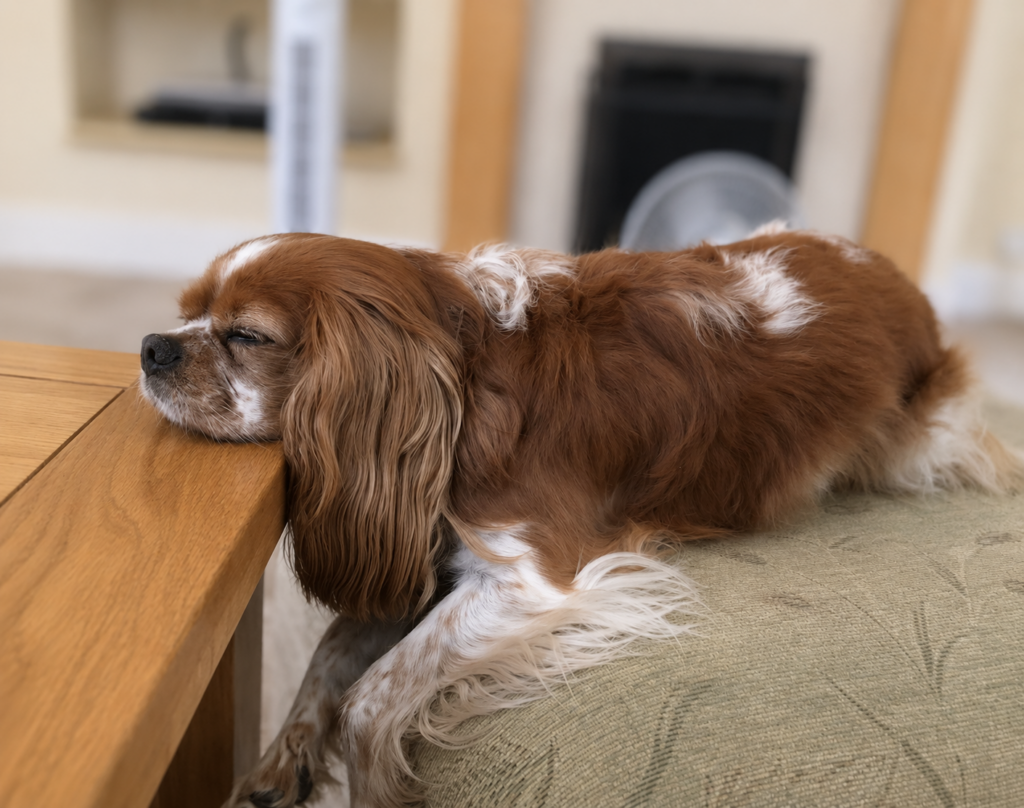
Could Your Cavalier’s Sleep Problems Be a Sign of Pain?
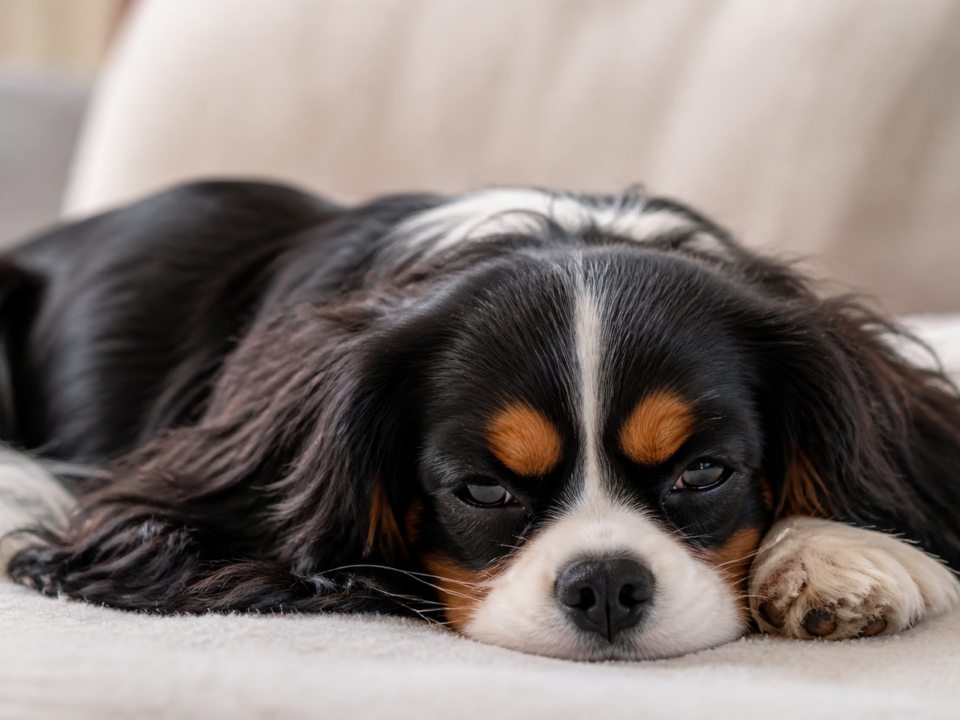
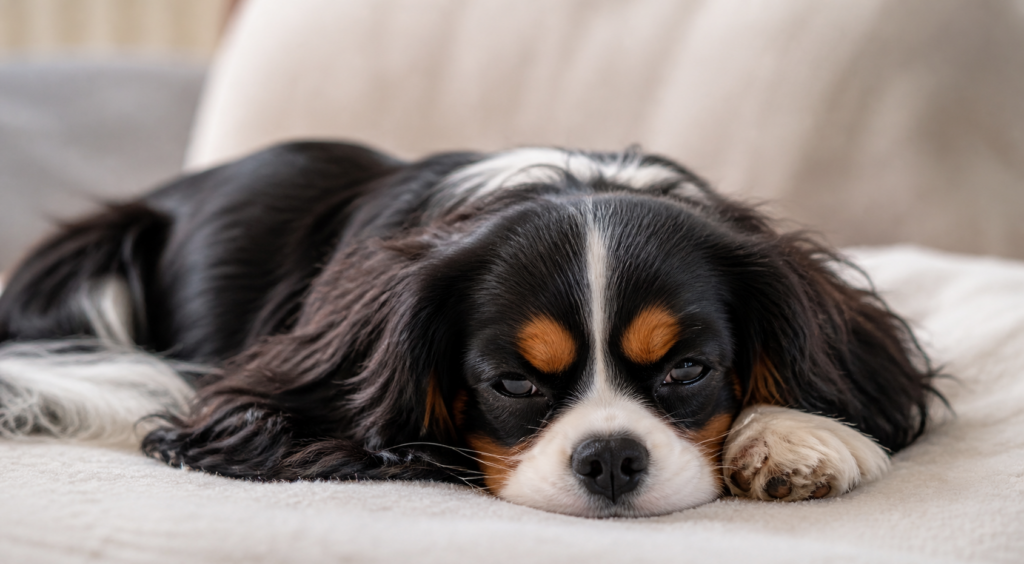
Many Cavalier King Charles Spaniels are known for their quirky sleeping habits. Some sleep with their heads propped up, some constantly change position throughout the night, and others seem unable to settle comfortably for long periods.
For years, owners of Cavaliers affected by Chiari-like malformation (CM) and syringomyelia (SM) have reported unusual sleeping behaviours. Until recently, however, there has been very little research examining whether these sleep disturbances might be linked to chronic pain.
A new study published in Veterinary Record has begun to explore this relationship, finding that Cavaliers showing signs of chronic neuropathic pain were also more likely to experience disturbed sleep and a poorer quality of life.
What Did the Study Find?
Researchers surveyed owners of 68 Cavalier King Charles Spaniels using validated questionnaires designed to assess:
- Sleep quality and nighttime restlessness
- Signs of neuropathic pain
- Overall quality of life
The results showed a significant association between higher pain scores and increased sleep disturbance. Dogs reported to have more signs of neuropathic pain were also more likely to have poorer owner-reported quality of life.
In simple terms, Cavaliers that appeared to be experiencing more pain were also more likely to struggle with sleep.
Why Is This Important?
Sleep disturbance is often overlooked when assessing a dog’s health.
Owners may notice that their dog:
- Frequently changes position during the night
- Appears restless when trying to settle
- Wakes repeatedly
- Sleeps with their head elevated
- Cries out or vocalises during sleep
- Seems unable to get comfortable
These behaviours are often dismissed as personality quirks or simply part of getting older.
However, this study suggests that disturbed sleep may sometimes be an important clue that a dog is experiencing chronic discomfort.
The Link Between Pain and Sleep
In people, the relationship between pain and sleep is well established.
Chronic pain can make it difficult to sleep, while poor sleep can increase pain sensitivity. This creates a cycle where pain disrupts sleep, and poor sleep makes pain feel worse.
Researchers believe a similar relationship may exist in dogs.
For Cavaliers affected by conditions such as Chiari-like malformation and syringomyelia, disturbed sleep could potentially be one of the ways chronic neuropathic pain manifests itself.
What About Chiari-Like Malformation and Syringomyelia?
Chiari-like malformation (CM) is extremely common in Cavalier King Charles Spaniels. Some dogs with CM develop syringomyelia (SM), while others experience significant pain despite having little or no syrinx formation.
Previous studies have already reported abnormal sleeping behaviours in Cavaliers affected by CM and SM, including unusual sleeping positions and vocalisation during sleep.
The authors of this new study note that sleep disturbances may not be caused by pain alone.
Cavaliers are also a brachycephalic breed and may be prone to sleep-disordered breathing. In addition, abnormalities affecting cerebrospinal fluid (CSF) flow may influence both pain and sleep quality.
The relationship is likely complex and involves multiple factors rather than a single cause.
Important Limitations
As with all research, the findings should be interpreted carefully.
This study was based on owner questionnaires rather than direct neurological examinations. The researchers did not confirm diagnoses through MRI scans, and not all dogs had diagnosed CM or SM.
The study therefore demonstrates an association between sleep disturbance and pain scores, but it does not prove that one directly causes the other.
Nevertheless, the findings are important because they highlight sleep as a potentially valuable part of assessing a Cavalier’s wellbeing.
What Owners Should Watch For
Changes in sleep patterns should never be ignored, particularly if they develop suddenly or are accompanied by other signs of discomfort.
Potential warning signs include:
- Difficulty settling at bedtime
- Frequent nighttime waking
- Excessive restlessness
- Sleeping sitting up or with the head elevated
- Crying out during sleep
- Increased daytime tiredness
- Reluctance to exercise or play
- Changes in behaviour or mood
While these signs do not automatically mean a dog has CM-associated pain, they may warrant further investigation.
The Take-Home Message
This study adds to a growing body of evidence suggesting that sleep quality may provide important insights into a Cavalier’s comfort and wellbeing.
Nighttime restlessness, frequent position changes and unusual sleeping behaviours should not simply be dismissed as “normal Cavalier behaviour.”
For some dogs, these changes may be subtle signs of chronic pain.
Paying attention to how your Cavalier sleeps could help identify problems earlier, improve quality of life, and ensure that dogs living with chronic pain receive the support and treatment they need.
Reference
Sherman AR, Quigley MA, Werre SR, Rossmeisl JH, Parker RL. Relationship between sleep and pain in Cavalier King Charles Spaniels. Veterinary Record. 2025; e70175.
DOI: 10.1002/vetr.70175