
Preventing Obesity and Inflammation in Cavalier King Charles Spaniels
29 July 2024
Help Us By Completing A Gift Aid Form
20 January 2025
Professor Clare Rusbridge has published the chiari malformation and Syringomyelia treatment algorithm for many years. Having access to the treatment information has been incredibly valuable, and this algorithm has undoubtedly improved the comfort, mobility and quality of life of thousands of Cavaliers worldwide.
Common signs of CM and SM in Cavalier King Charles Spaniels can include:
• Yelping or crying out when lifted
• Reluctance to jump, climb stairs, or exercise
• Phantom scratching (scratching at the air, usually near the shoulder or neck)
• Scratching at the back of the head or ears
• Neck pain or spinal pain
• Face rubbing or head rubbing
• Squinting or signs of headache-like discomfort
• Sensitivity around the head, neck, or shoulders
• Disturbed sleep or difficulty settling comfortably
• Behavioural changes, including irritability, anxiety, withdrawal, or aggression
• Weakness, wobbliness, or altered gait
• Scoliosis (curvature of the spine)
Not every Cavalier with CM or SM will show all of these symptoms, and some dogs have much subtler signs of chronic pain.
What is Chiari-like Malformation (CM)?
Chiari Malformation, or CM, happens when the skull is too small, which makes things cramped for the brain.
This pushes part of the brain, called the cerebellum, down into the spinal canal. It can mess up the flow of cerebrospinal fluid (CSF), leading to pressure and pain. Sometimes, this also causes headaches or discomfort at the front of the head.
The most common symptoms are pain when being lifted or when moving from lying down (some yelp or groan), rubbing their face or head, sensitivity to touch, spine pain, changes to behaviour, e.g., aggression or withdrawn, disturbed sleep, and trouble jumping or climbing stairs.
The average age when symptoms first appear is typically between six months and three years old.
What is Syringomelia? (SM)
Syringomyelia, or SM, occurs when the flow of spinal fluid (CSF) is disrupted, causing fluid-filled pockets called syrinxes to form in the spinal cord. These syrinxes can lead to intense pain, abnormal nerve sensations that make dogs typically scratch up at the shoulder area (phantom scratching). They can also suffer from progressive weakness, scoliosis, and postural deficits.
CM and SM significantly affect the quality of life for many Cavalier King Charles Spaniels. Unfortunately, these conditions are vastly underdiagnosed, meaning many Cavaliers suffer without any pain relief at all. Many people think the symptoms are simply ‘quirky’ things that their dogs do or that their dog is ‘wussy’.
Some Cavaliers’ symptoms are more subtle, but they are still in pain, so they need treatment. Many Cavaliers improve dramatically with medication, and treatment is often far more accessible than owners realise. Many dogs can be successfully managed for around £10–£40 per month.
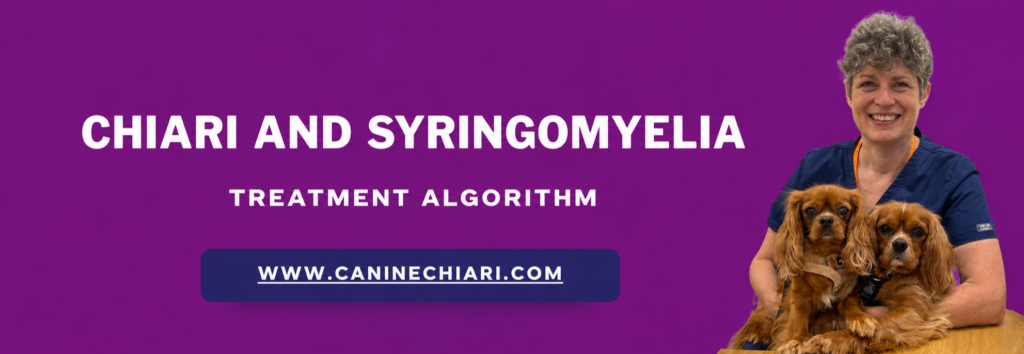
Professor Clare Rusbridge Chiari (CM) and Syringomyelia (SM) Treatment Algorithm
Professor Clare Rusbridge, a renowned veterinary neurologist, identified Syringomyelia (SM) in dogs during the 1990s. Her pioneering work has significantly advanced our understanding of this condition, particularly in Cavalier King Charles Spaniels.
Professor Rusbridge shares educational resources through her YouTube channel @clare-neurovet and NeuroVet website, helping both veterinarians and owners better recognise and manage CM and SM.  She has also developed an innovative diagnostic tool called Chiari Check (caninechiari.com). This tool identifies and monitors Chiari-related pain and Syringomyelia symptoms, even when MRI scans are inaccessible due to funds or when a dog may be at high risk for an anaesthetic. Chiari Check scores the likelihood of the dog having chiari malformation and/or Syringomyelia by percentages, which can be given to the general practice veterinarian. That veterinarian can then work with the owner on a medication trial using the treatment algorithm and a referral to a neurologist if the owner wants to proceed.
The Latest CM SM Treatment Algorithm
Clare has released an interactive CMSM treatment algorithm. The PDF includes easy-to-use links to her YouTube videos, which explain the symptoms, treatment choices, and other things vets and owners can do to help their suffering Cavaliers.
Owners are reporting that the videos are incredibly helpful for them and their veterinarians. Managing pain and improving the quality of life for Cavaliers (or other breeds that suffer from CMSM) can be tricky when the condition is severe. Still, the treatment algorithm PDF breaks everything down in an easy-to-understand way.
Treatment options have come a long way, and we are incredibly fortunate to have Clare’s expertise in managing these conditions. Visit the link below for more information.
This information is designed to support discussions with your veterinary surgeon and does not replace individual veterinary advice.