
Scammers Offering Dogs For Adoption and Posing as Rescue Charities
15 May 2026
Gallbladder Disease in Cavalier King Charles Spaniels
16 May 2026
Mitral Valve Disease in Cavalier King Charles Spaniels: Symptoms, Scans, Stages and Treatment
Mitral valve disease (MVD) is the most common heart condition seen in Cavalier King Charles Spaniels. For many owners, hearing the words “heart murmur” for the first time can feel frightening and overwhelming, especially when Cavaliers are so well known for developing heart disease earlier than many other breeds.
The good news is that a diagnosis of MVD is not an immediate emergency, and it does not mean your dog is suddenly suffering. Many Cavaliers live happily for years with careful monitoring, regular check-ups, and medication when it becomes appropriate. Advances in veterinary cardiology have also significantly improved how we monitor and manage the condition.
This guide explains the basics of mitral valve disease in Cavaliers in clear, practical language. We’ll cover what MVD actually is, what heart murmurs mean, when a heart scan may be recommended, how the staging system works, and the treatments commonly used as the disease progresses.
We also understand how confusing heart terminology can feel at first. Owners are often suddenly faced with phrases like “B2 disease”, “heart enlargement”, “LA:Ao ratio”, or “congestive heart failure” without fully understanding what they mean for their own dog. We aim to help make those conversations easier to understand and less intimidating.
At Bliss Cavalier Rescue, we care for a large number of Cavaliers affected by mitral valve disease, from dogs with very mild murmurs through to those requiring complex cardiac medication. While every dog is different, understanding the condition early can help owners make informed decisions and recognise when monitoring or treatment may be beneficial.
What Is Mitral Valve Disease?
Mitral Valve Disease is a progressive heart condition affecting the mitral valve, which sits between the left atrium and the left ventricle of the heart. The mitral valve acts like a one-way door, helping blood flow efficiently through the heart in the correct direction.
In dogs with mitral valve disease, the valve gradually becomes thickened, weakened, and less effective at closing properly. This allows some blood to leak backwards each time the heart beats, a process known as regurgitation.
Over time, this extra strain can cause parts of the heart, particularly the left atrium, to enlarge as the heart works harder to compensate. In the early stages, many dogs show no symptoms at all, and the condition may only be detected as a heart murmur during a routine examination.
As the disease progresses, some dogs eventually develop signs associated with congestive heart failure, where fluid can begin to build up in or around the lungs. However, this progression is often gradual, and many Cavaliers remain stable for long periods with appropriate monitoring and treatment.
Cavaliers are unfortunately predisposed to developing MVD much earlier than many other breeds. While mild age-related valve changes can occur in many older dogs, Cavaliers frequently develop murmurs and valve disease at a younger age, which is why heart screening and responsible breeding are such important topics within the breed.
A key thing for owners to understand is that:
- a heart murmur does not automatically mean heart failure
- not every dog with MVD needs medication immediately
- and many Cavaliers continue to enjoy a very good quality of life for years after diagnosis
The aim of monitoring is to identify when the disease begins causing significant changes to the heart itself, rather than simply focusing on the presence of a murmur alone.
Why Are Cavaliers So Affected by Mitral Valve Disease?
Cavalier King Charles Spaniels are unfortunately one of the breeds most heavily affected by Mitral Valve Disease. While many older dogs of different breeds may eventually develop mild valve degeneration as part of ageing, Cavaliers are known for developing the disease both earlier and more frequently. 
Research over many years has shown that MVD has a strong inherited component within the breed. This means the risk is heavily influenced by genetics, which is why responsible breeding and cardiac screening are so important.
One of the major concerns in Cavaliers is not simply whether a dog develops MVD, but how early it develops. A Cavalier developing a murmur at 10 or 11 years old is very different from a Cavalier developing significant heart disease at 3, 4, or 5 years old.
Because of this, breeding recommendations focus heavily on:
- delaying the age of onset
- breeding from older heart-clear dogs
- and using dogs that have been screened by experienced veterinary cardiologists
Many owners are surprised to learn that the phrase “heart tested parents” can mean very different things depending on the breeder. In some cases, it may simply mean a routine stethoscope check performed at a standard vet visit. In more responsible breeding programmes, it refers to formal cardiac screening carried out regularly under recognised heart testing schemes.
Unfortunately, rescue organisations like Bliss Cavalier Rescue see the real-world impact of early-onset heart disease far too often. We regularly care for Cavaliers requiring lifelong cardiac medication, repeated scans, and ongoing monitoring, sometimes at relatively young ages.
This does not mean every Cavalier will develop severe heart disease early in life. Many live long, happy lives with mild or slowly progressing disease. However, understanding the breed’s predisposition helps owners make informed decisions about:
- puppy buying
- insurance and financial planning
- routine monitoring
- and recognising symptoms early
For owners considering a puppy, learning about cardiac screening and breed health testing is one of the most important steps you can take before bringing a Cavalier home.
What Is a Heart Murmur?
A heart murmur is an abnormal sound heard when a vet listens to the heart with a stethoscope. In Cavaliers, the most common cause of a murmur is Mitral Valve Disease, where blood leaks backwards through the mitral valve as the heart beats.
Many owners understandably panic when they first hear the words “heart murmur”, but a murmur itself is not a diagnosis of heart failure. A murmur is simply a sound that suggests turbulent blood flow within the heart.
In the early stages of MVD, a Cavalier may have:
- a completely normal energy level
- no breathing problems
- no coughing
- and no outward symptoms at all
In fact, many murmurs are picked up during routine vaccinations or health checks long before a dog becomes clinically unwell.
Heart murmurs are graded on a scale from 1 to 6 depending on how loud they sound through the stethoscope.
| Murmur Grade | Description |
|---|---|
| Grade 1 | Very quiet murmur, difficult to hear |
| Grade 2 | Soft but consistently heard |
| Grade 3 | Moderately loud murmur |
| Grade 4 | Loud murmur heard clearly on both sides of the chest |
| Grade 5 | Very loud murmur with a palpable vibration (thrill) |
| Grade 6 | Extremely loud murmur heard even with minimal stethoscope contact |
It is important to understand that murmur grade alone does not tell us exactly how advanced the disease is.
Some Cavaliers with relatively loud murmurs may remain stable for long periods with minimal heart enlargement, while others with quieter murmurs may already have significant structural changes occurring inside the heart. This is why an echocardiogram (heart scan) becomes so valuable, as it allows vets to assess what is actually happening within the heart itself.
As a general guide, many Cavaliers are referred for a heart scan once a murmur reaches around Grade 3, although this can vary depending on:
- the dog’s age
- symptoms
- breathing changes
- progression over time
- and the vet’s clinical concerns
The presence of a murmur should be seen as a prompt for monitoring and assessment rather than an immediate cause for panic. Many Cavaliers continue to live happy, active lives for years after a murmur is first detected.
🫀 Quick Summary
- A heart murmur is a sound, not a diagnosis of heart failure.
- Many Cavaliers live for years with mild mitral valve disease.
- Murmur grade alone does not tell us how advanced the disease is.
- A heart scan helps assess what is actually happening inside the heart.
When Should a Cavalier Have a Heart Scan?
An echocardiogram, often referred to simply as a heart scan, is one of the most useful tools for assessing Mitral Valve Disease in Cavalier King Charles Spaniels.
While a stethoscope allows a vet to hear a murmur, a heart scan allows them to actually see the structure and function of the heart in real time. This helps determine whether the disease is mild and stable, or whether changes such as heart enlargement are beginning to occur.
In many Cavaliers, a heart scan is recommended once a murmur reaches around Grade 3, particularly in middle-aged or older dogs. However, there is no single “perfect” point that applies to every dog. The decision will depend on several factors, including:
- the murmur grade
- how quickly the murmur has progressed
- the dog’s age
- symptoms or breathing changes
- and whether medication may soon be beneficial
A scan may also be recommended earlier if a dog develops:
- exercise intolerance
- increased resting breathing rate
- coughing
- collapse episodes
- breathing difficulty
- or unusual lethargy
Ideally, echocardiograms are performed by a veterinary cardiologist, particularly for breeding assessments or more complex cases. However, many experienced first-opinion vets are also very capable of performing high-quality heart scans and monitoring uncomplicated MVD cases at a lower cost, usually. Access to cardiologists can vary significantly depending on location and cost, so it is important that owners do not feel that a scan is “pointless” unless they can access a specialist.
One of the biggest misconceptions about heart disease is that the loudness of the murmur tells us everything we need to know. In reality, scans are far more useful for understanding:
- whether the heart is enlarging
- how severe the valve leakage is
- whether the disease has reached Stage B2
- and whether medication such as pimobendan (Vetmedin) may be appropriate
This is why two Cavaliers with the same murmur grade may have very different scan results and treatment plans.
Heart scans are also valuable because they provide a baseline. Even if medication is not needed immediately, future scans can be compared over time to monitor progression and identify changes earlier.
What Happens During a Heart Scan?
Many owners feel understandably anxious before their dog’s first heart scan, but an echocardiogram is generally a very safe, calm, and non-invasive procedure.
Unlike MRI scans or some advanced imaging tests, dogs are usually fully awake throughout the scan and sedation is not normally required.
During the appointment, your dog will typically be gently positioned lying on their side on a padded examination table. A small area of fur on the chest may be clipped to allow good contact between the ultrasound probe and the skin. Ultrasound gel is then applied, and the vet or cardiologist uses the probe to examine the heart in real time.
The scan itself is painless. Most dogs tolerate it very well, particularly when handled calmly and gently.
The echocardiogram allows the vet to assess:
- the mitral valve itself
- how much leakage is occurring
- whether the heart chambers are enlarged
- heart muscle function
- blood flow through the heart
- and whether changes associated with congestive heart failure are developing
Measurements are taken throughout the scan, and owners may hear terms such as:
- “left atrial enlargement”
- “LA:Ao ratio”
- “remodelling”
- “mild”, “moderate”, or “severe” disease
- or references to ACVIM stages such as B1 or B2
The appointment length can vary, but many scans take somewhere between 20 and 45 minutes, depending on the complexity of the case.
Some dogs may also have additional tests alongside the echocardiogram, including:
- chest X-rays
- blood pressure measurement
- ECG monitoring
- or resting respiratory assessments
It is also important for owners to know that scan findings need to be interpreted alongside the dog’s overall clinical picture. A measurement on its own rarely tells the full story. Factors such as symptoms, breathing rate, exercise tolerance, age, and progression over time are all important when deciding whether treatment or closer monitoring is needed.
Understanding the Stages of Mitral Valve Disease
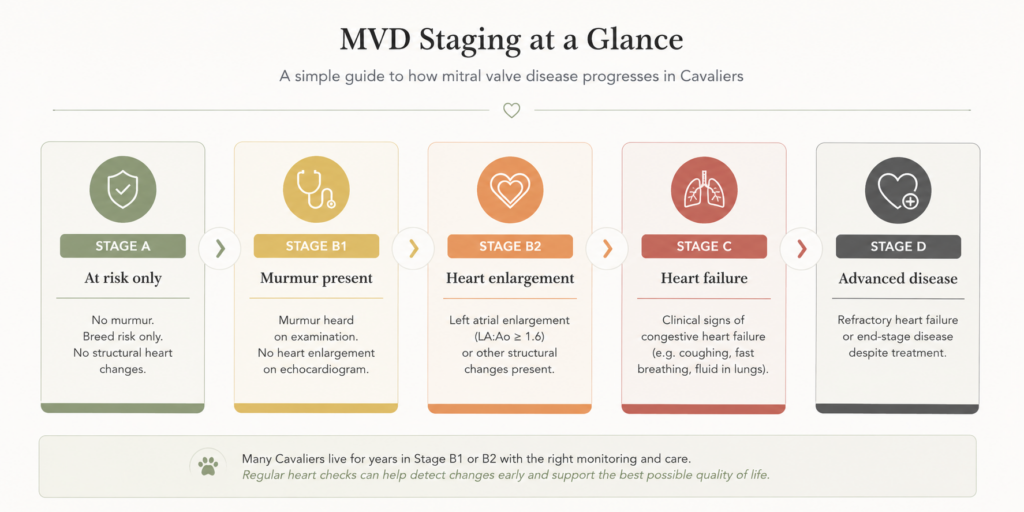
Veterinary professionals commonly use the ACVIM staging system to classify Mitral Valve Disease in dogs. These stages help describe how advanced the disease is and guide decisions around monitoring and treatment.
Many owners are surprised to learn that a dog can have a heart murmur for years before reaching congestive heart failure. The staging system helps separate dogs with mild, stable disease from those needing medication or more intensive management.
Stage A
Stage A dogs are considered at risk of developing heart disease, but do not currently have any detectable changes.
In Cavaliers, this stage generally refers to:
- young dogs with no murmur
- or Cavaliers from predisposed bloodlines who are still heart clear
No treatment is needed at this stage, but routine monitoring is important as the dog ages.
Stage B1
At Stage B1, a heart murmur is present, but there is no significant enlargement of the heart on imaging.
Many Cavaliers spend a long time in this stage and may remain completely symptom-free. In most cases:
- the dog is still active and comfortable
- breathing is normal
- and medication is not yet required
Regular monitoring is usually recommended to assess whether the disease is progressing.
Stage B2
Stage B2 is reached when the heart has started to enlarge due to the strain caused by the leaking mitral valve.
This is one of the most important stages in MVD management because many dogs begin medication here, particularly pimobendan (Vetmedin).
Research, including the well-known EPIC study, showed that starting pimobendan in dogs with Stage B2 disease significantly delayed the onset of congestive heart failure in many cases.
Dogs at this stage are often still outwardly well, which can be confusing for owners. A Cavalier may:
- still enjoy walks
- appear bright and happy
- and show no obvious symptoms
However, changes are already occurring within the heart itself, which is why scans and measurements are so important.
Stage C
Stage C refers to dogs that have developed signs of congestive heart failure (CHF).
This occurs when the heart can no longer compensate effectively, leading to fluid build-up, most commonly in the lungs.
Symptoms may include:
- increased breathing effort
- rapid resting respiratory rate
- coughing
- exercise intolerance
- weakness
- collapse episodes
- or difficulty settling comfortably at night
At this stage, dogs typically require ongoing cardiac medication and closer monitoring.
Stage D
Stage D describes advanced or end-stage heart disease, where the condition is no longer responding fully to standard treatment protocols.
Dogs at this stage often require:
- multiple medications
- frequent monitoring
- medication adjustments
- and intensive supportive care
Some dogs can still maintain a good quality of life for a period of time with careful management, while others may deteriorate more rapidly.
It is important to remember that progression through these stages varies enormously between dogs. Some Cavaliers progress very slowly over many years, while others experience more rapid changes. The presence of a murmur alone does not tell us which path an individual dog will follow, which is why regular monitoring and heart scans are so valuable.
Understanding Heart Scan Measurements
One of the most overwhelming parts of a heart scan for many owners is hearing lots of unfamiliar measurements and abbreviations. Terms like “LA:Ao”, “VHS”, or “LVIDDN” can sound intimidating at first, but these measurements are simply tools vets use to assess how much the heart has been affected by Mitral Valve Disease.
Importantly, no single number should ever be looked at in isolation. Measurements are interpreted alongside:
- your dog’s symptoms
- breathing rate
- physical examination findings
- murmur progression
- and overall clinical picture
Below are some of the most common terms owners may encounter during cardiac investigations.
LA:Ao Ratio
The LA:Ao ratio compares the size of the left atrium (LA) to the aorta (Ao).
As mitral valve disease progresses and blood leaks backwards through the valve, the left atrium may gradually enlarge due to increased pressure and volume overload.
An increased LA:Ao ratio is one of the key indicators used to determine whether a dog has progressed into Stage B2 disease.
The LA:Ao ratio is one of the most commonly used measurements in Cavalier heart scans and is a key factor in determining whether a dog has progressed into Stage B2 disease.
In general:
- a normal LA:Ao ratio is usually considered to be below around 1.6
- values above this suggest left atrial enlargement
- and an LA:Ao ratio of 1.6 or greater is one of the measurements commonly used when assessing for Stage B2 disease
Owners will often hear phrases such as:
- “mild left atrial enlargement”
- “moderate enlargement”
- or “significant enlargement”
These changes help guide decisions around monitoring and medication.
LVIDDN
LVIDDN stands for Left Ventricular Internal Diameter in Diastole Normalised.
While the name sounds complicated, it is essentially a way of measuring whether the main pumping chamber of the heart has enlarged beyond what would be expected for the dog’s body size.
This measurement is particularly important when assessing whether the heart is beginning to remodel in response to chronic valve leakage.
Heart Remodelling
Owners are often told their dog’s heart is “remodelling” or “showing remodelling changes”.
This refers to structural changes that occur as the heart adapts to the strain caused by mitral valve leakage. Over time, parts of the heart may enlarge or thicken as they work harder to compensate.
Remodelling itself does not automatically mean a dog is in heart failure, but it does indicate that the disease is progressing beyond the earliest stages.
Doppler Assessment
During the scan, colour Doppler imaging is commonly used to visualise blood flow through the heart.
This allows the vet or cardiologist to:
- see the leaking jet of blood through the mitral valve
- assess the severity of regurgitation
- and evaluate overall blood flow patterns
Owners often notice colourful moving images on the screen during this part of the examination.
VHS (Vertebral Heart Score)
A Vertebral Heart Score is measured using chest X-rays rather than ultrasound.
This measurement helps assess overall heart size and can be useful for monitoring progression over time, particularly when evaluating dogs with suspected congestive heart failure.
It is completely normal for owners to feel overwhelmed by scan reports initially. Even experienced owners can struggle with the terminology. What matters most is understanding the bigger picture:
- whether the heart is enlarging
- whether the disease appears stable or progressive
- and whether treatment or closer monitoring is recommended
In many cases, trends over time are more important than a single measurement from one scan alone.
Symptoms of Mitral Valve Disease in Cavaliers
One of the most important things for owners to understand about Mitral Valve Disease is that many dogs show no obvious symptoms during the earlier stages of the disease.
In fact, a large number of Cavaliers with heart murmurs continue to:
- enjoy walks
- play normally
- eat well
- and behave completely like themselves for years
This is why regular monitoring and heart scans are often more useful than relying on symptoms alone in the earlier stages.
As the disease progresses, however, some dogs may begin to develop signs associated with heart enlargement or congestive heart failure.
Symptoms owners may notice include:
- Reduced stamina on walks
- Becoming tired more quickly than usual
- Slower recovery after exercise
- Increased sleeping or lethargy
- Panting more easily
- Restlessness at night
- Increased breathing rate during sleep
- Coughing
- Breathing with more abdominal effort
- Weakness or collapse episodes
- Reduced appetite in more advanced cases
One of the most valuable things owners can monitor at home is their dog’s resting or sleeping respiratory rate. In a relaxed, sleeping dog, this is often under around 30 breaths per minute, although your vet or cardiologist may advise monitoring your own dog’s normal baseline over time rather than focusing on one exact number. Many owners find apps such as the Cardalis App helpful for recording and tracking breathing rates, but this can also be done perfectly well using any simple timer or phone stopwatch while your dog is asleep and fully relaxed.
Cardalis downloads – Apple App Store or Google Play Store
In a relaxed, sleeping dog, the normal resting respiratory rate is generally under 30 breaths per minute.
Consistently higher readings, particularly if they are increasing over time, can sometimes indicate fluid changes or worsening heart disease and should be discussed with your vet.
A consistently increased sleeping breathing rate can sometimes be an early indicator that fluid changes may be developing before more dramatic symptoms appear. Many cardiologists recommend monitoring trends over time rather than focusing on a single isolated reading.
It is also important to understand that coughing in Cavaliers is not always caused by heart disease.
This can be particularly confusing because Cavaliers commonly suffer from several other conditions that may also cause coughing or noisy breathing, including:
- airway disease
- brachycephalic airway changes
- reflux
- tracheal irritation
- syringomyelia-related distress
- or respiratory infections
Similarly, older Cavaliers may slow down for many different reasons unrelated to their heart, such as arthritis, neurological disease, chronic pain, or general ageing.
For this reason, symptoms should always be interpreted alongside veterinary examination findings and scan results rather than assuming every cough or breathing change automatically means congestive heart failure.
Owners should seek veterinary advice promptly if they notice:
- rapid or laboured breathing
- significant changes in sleeping respiratory rate
- collapse episodes
- distress at rest
- blue or pale gums
- or sudden deterioration in exercise tolerance
Early assessment and treatment can make a significant difference to both comfort and long-term management.
Treatment for Mitral Valve Disease
Treatment for Mitral Valve Disease depends on the stage of the disease and how much impact it is having on the heart itself.
One of the biggest misconceptions owners have is that every Cavalier with a heart murmur immediately needs medication. In reality, many dogs – particularly those in Stage B1 – may remain stable for long periods with monitoring alone.
The aim of treatment is to:
- reduce strain on the heart
- slow progression where possible
- improve quality of life
- and manage symptoms if congestive heart failure develops
Monitoring and Repeat Scans
In the earlier stages of MVD, monitoring is often the most important part of management.
This may include:
- regular vet examinations
- repeat heart scans
- tracking resting respiratory rate at home
- blood pressure checks
- and monitoring for symptom changes over time
Some dogs may only need periodic reassessment for quite some time before medication becomes necessary.
Pimobendan (Vetmedin/Cardisure/Zelys/Cardisan)
Pimobendan, commonly known by the brand name Vetmedin, is one of the most widely used medications in canine heart disease. Other brand names include Cardisure, Zelys or Cardisan.
It is most commonly started once a dog reaches Stage B2 disease, where the heart has begun to enlarge but congestive heart failure has not yet developed.
Studies showed that starting pimobendan at this stage delayed the onset of congestive heart failure in many dogs.
Pimobendan works by:
- helping the heart pump more effectively
- and reducing workload on the heart
Many owners worry when their dog is prescribed Vetmedin because the dog may still appear completely well. However, treatment decisions are often based on scan findings rather than visible symptoms alone.
Diuretics
Once congestive heart failure develops, diuretics are commonly used to help remove excess fluid from the lungs and body.
The most frequently used diuretic in dogs with MVD is furosemide, although other medications such as torasemide (UpCard) may also be used in some cases.
These medications can dramatically improve breathing comfort in dogs experiencing fluid build-up.
ACE Inhibitors and Additional Medications
Some dogs may also be prescribed medications such as:
- benazepril
- ramipril
- spironolactone
- or combination medications such as Cardalis
These drugs are used to support heart function and help manage progression or fluid retention, depending on the individual case.
Not every dog will need the same combination of medications, and treatment plans are often adjusted over time based on scan results and symptoms.
Advanced and Long-Term Management
Many Cavaliers with heart disease eventually require multiple medications alongside regular monitoring.
Some dogs remain remarkably stable for years with appropriate treatment, while others may progress more rapidly despite careful management.
Long-term care may involve:
- repeat echocardiograms
- chest X-rays
- blood tests
- kidney monitoring
- blood pressure checks
- and medication adjustments
Owners should never change or stop cardiac medications without veterinary guidance, even if their dog appears improved.
Blood Pressure Monitoring in Cavaliers with Mitral Valve Disease
Blood pressure monitoring is an important but often overlooked part of managing Mitral Valve Disease in Cavalier King Charles Spaniels.
Just like in people, blood pressure can affect how hard the heart has to work. High blood pressure (hypertension) may place additional strain on the heart and blood vessels, while excessively low blood pressure can sometimes occur as a side effect of cardiac medication or advanced disease.
Monitoring blood pressure can help vets:
- assess overall cardiovascular health
- guide medication choices
- monitor response to treatment
- and identify potential complications earlier
This becomes particularly important in Cavaliers receiving multiple cardiac medications, especially dogs with more advanced disease or congestive heart failure.
Blood pressure measurement in dogs is usually:
- quick
- non-invasive
- and well tolerated
A cuff is placed around a leg or tail, similar to how blood pressure is measured in humans. Some dogs may feel slightly nervous during the procedure, so readings are often interpreted alongside the dog’s stress level and overall behaviour at the appointment.
Certain medications commonly used in heart disease management may also influence blood pressure. For example:
- ACE inhibitors such as benazepril or ramipril can lower blood pressure
- diuretics may affect circulation and kidney function
- and dogs with advanced heart disease sometimes develop lower blood pressure as the condition progresses
Because many Cavaliers with MVD are older dogs, blood pressure monitoring can also help identify other age-related conditions that may occur alongside heart disease, including kidney disease or hormonal disorders.
In some cases, persistently high blood pressure may itself require treatment. Medications such as amlodipine are occasionally used where hypertension is identified. Blood pressure readings should never be interpreted in isolation, and a single mildly elevated reading does not automatically mean a dog has hypertension. Trends over time and the dog’s overall clinical picture are far more important.
Regular monitoring allows treatment plans to be adjusted safely and helps ensure dogs remain as comfortable and stable as possible throughout the progression of their heart disease.
Home blood pressure monitoring is also becoming a more realistic option for some owners, as veterinary blood pressure machines have become more affordable and accessible in recent years. An added benefit is that many dogs are significantly calmer in their home environment, which can help produce more accurate readings by reducing stress-related increases in blood pressure. Just remember, blood pressure should never be judged from a single reading alone; multiple readings are usually taken during each session and averaged together to give a more reliable result.
Can Cavaliers Live a Long Life With Mitral Valve Disease?
A diagnosis of Mitral Valve Disease does not mean a Cavalier’s quality of life is immediately poor, nor does it mean congestive heart failure is imminent.
Many Cavaliers live happily with mild or moderate mitral valve disease for years, particularly when the condition is monitored carefully, and treatment is introduced at the appropriate stage.
One of the most important things owners should understand is that progression varies enormously between dogs. Some Cavaliers develop a slow-moving disease that remains stable for a long time, while others experience a more rapid progression despite good care and monitoring.
Factors that may influence prognosis include:
- the age the murmur first develops
- how quickly the disease progresses
- scan findings and heart enlargement
- response to medication
- the presence of congestive heart failure
- and overall health alongside the heart disease
Even dogs with advanced heart disease can often continue to enjoy:
- short walks
- time with their family
- good appetite
- and a happy daily routine with appropriate medication and monitoring
Modern veterinary cardiology has significantly improved outcomes for dogs with MVD, and medications such as pimobendan have helped many Cavaliers maintain stability and quality of life for longer than was previously possible.
Owners often find the diagnosis emotionally overwhelming at first, particularly because heart disease is so well known within the breed. However, many dogs continue to enjoy a very normal and happy life after diagnosis, especially in the earlier stages of the disease.
Regular monitoring, recognising changes early, and working closely with your veterinary team can make a significant difference to long-term management and comfort.
📞 When to Contact Your Vet
Contact your vet promptly if you notice:
- A resting or sleeping breathing rate consistently above 30 breaths per minute
- Increased breathing effort or laboured breathing
- Sudden coughing or worsening coughing episodes
- Collapse episodes, weakness, or fainting
- Distress at rest or difficulty settling comfortably
- A sudden reduction in exercise tolerance or energy levels
The Cavalier Heart Scheme and Responsible Breeding
For Cavaliers used for breeding, routine vet checks are not enough. The official Cavalier King Charles Spaniel Heart Scheme assesses dogs for mitral valve disease and other significant heart disease using both auscultation and echocardiography, carried out by approved cardiologists. The assessment gives two results: a mitral murmur grade and a mitral valve prolapse grade. Mitral valve prolapse means “ballooning” of the mitral valve, and importantly, this can sometimes be detected on a scan before a murmur is heard.
The scheme allows dogs to be tested from 18 months and recommends assessment at 2, 4 and 6 years of age. However, because MVD is age-related and often develops as Cavaliers get older, very young results should be interpreted with caution. For puppy buyers, a heart certificate from a very young dog is not as reassuring as clear, repeated results from mature dogs. Ideally, breeding dogs should have meaningful adult heart screening, and results from dogs over around 2.5 years of age are generally more useful than relying on very early screening alone.
The scheme uses a traffic light system that takes age into account. A young dog with a murmur or mitral valve prolapse is considered more concerning than an older dog with the same finding, because early-onset disease is a major issue in the breed.
| Result | What it broadly means | Breeding advice |
|---|---|---|
| Green | Lowest risk category under the scheme | Lowest risk of developing clinical MVD and lowest risk of passing it to offspring |
| Amber | Higher risk category | Should only be used cautiously, only if otherwise healthy, with good results from other screening schemes, and only with a green-rated mate |
| Red | Highest risk category | Should not be used for breeding |
It is important to understand that “green” does not mean a dog can never develop MVD, and it does not guarantee that puppies will be free from heart disease. The inheritance of MVD is complex and not fully predictable. However, using the scheme properly helps reduce the risk of producing puppies affected by early or more serious heart disease.
For puppy buyers, this means asking for actual heart scheme certificates, not simply accepting phrases such as “vet checked”, “heart checked”, or “no murmur heard at vaccination”. A proper breeding assessment should involve the recognised Cavalier heart scheme, age-appropriate results, and ideally repeated testing as the dog matures.
Heart Disease Is Common In Cavaliers – But So Is Good Quality of Life
Mitral Valve Disease is unfortunately a reality for many Cavalier King Charles Spaniel owners, but understanding the condition can make it far less frightening and overwhelming.
A heart murmur is not an automatic emergency, and many Cavaliers continue to live happy, active lives for years with careful monitoring and appropriate treatment when needed. Advances in veterinary cardiology have significantly improved both quality of life and long-term management for dogs affected by MVD.
One of the most important things owners can do is focus on:
- regular monitoring
- recognising changes early
- maintaining good communication with their veterinary team
- and understanding what their dog’s scan results and staging actually mean
For puppy buyers, learning about heart screening and responsible breeding is equally important. Early-onset mitral valve disease remains one of the biggest health challenges facing the breed, and informed breeding decisions are essential if long-term progress is to be made.
At Bliss Cavalier Rescue, we care for Cavaliers across every stage of heart disease, from dogs with newly detected murmurs through to those requiring complex cardiac management. While every dog’s journey is different, many continue to enjoy an excellent quality of life with the right support, medication, and monitoring.
If your Cavalier has recently been diagnosed with a heart murmur or mitral valve disease, try not to panic. Take things step by step, ask questions, and remember that a diagnosis of MVD does not define your dog.
Mitral Valve Disease in Cavalier King Charles Spaniels FAQ
Does every Cavalier with a heart murmur need medication?
No. Many Cavaliers with mild mitral valve disease, particularly those in Stage B1, may not need medication immediately. Treatment decisions are usually based on heart scan findings, heart enlargement, symptoms, and overall progression rather than the presence of a murmur alone.
What age should Cavaliers start having heart checks?
Cavaliers should have routine veterinary heart checks throughout life, particularly as they get older. For breeding dogs, formal heart scheme assessments are typically performed from around 2.5 years onwards and repeated regularly, as very young heart certificates are less reliable predictors of future disease.
Can a normal vet perform a heart scan?
Yes. While veterinary cardiologists are ideal for more complex cases and breeding assessments, many experienced first opinion vets are also capable of performing high-quality echocardiograms and monitoring uncomplicated mitral valve disease.
Is coughing always caused by heart disease in Cavaliers?
No. Cavaliers commonly experience several conditions that may also cause coughing or breathing changes, including airway disease, reflux, respiratory infections, and brachycephalic airway issues. This is why symptoms should always be interpreted alongside examination findings and heart scans.
Can Cavaliers live happily with mitral valve disease?
Yes. Many Cavaliers live comfortably for many years with careful monitoring and appropriate treatment. Progression varies significantly between dogs, and a diagnosis of mitral valve disease does not automatically mean a poor quality of life or immediate heart failure.