Ruby’s Last Chance: A Splenectomy and Bone Marrow Biopsy
1 August 2026
Luxating Patellas in Cavaliers: What Owners Need to Know
Luxating patellas are extremely common in small-breed dogs, including the Cavalier King Charles Spaniel.
For some dogs, a luxating patella can cause significant pain, lameness, and deterioration of the knee joint, and surgical treatment may be the best option. For many others, however, it can be a relatively mild finding that causes little or no noticeable difficulty.
At Bliss Cavalier Rescue, we regularly examine dogs whose owners have never noticed anything unusual about their movement, only for a thorough veterinary examination to identify a luxating patella.
That is why a diagnosis of patellar luxation does not automatically mean that a dog needs surgery.
The important question is not simply:
“Does this dog have a luxating patella?”
It is:
“What effect is this luxating patella having on this particular dog?”
What is a luxating patella?
The patella is the kneecap.
Normally, it sits within a groove at the end of the femur called the trochlear groove and moves smoothly up and down within that groove as the knee bends and straightens.
With patellar luxation, the kneecap moves out of its normal position.
Most commonly in small dogs, it moves towards the inside of the leg. This is called a medial patellar luxation (MPL).
Less commonly, the kneecap moves towards the outside of the leg, known as a lateral patellar luxation (LPL).
Patellar luxation may affect one knee or both.
What causes a luxating patella?
It is tempting to think of the condition simply as a “loose kneecap”, but in many dogs the problem is more complicated than that.
The patella forms part of what vets call the quadriceps mechanism. For the kneecap to track normally, the muscles of the thigh, femur, patella, patellar tendon and the point where that tendon attaches to the tibia all need to be appropriately aligned.
In dogs with developmental patellar luxation, abnormalities in the shape and alignment of these structures can cause the kneecap to be pulled away from its normal groove.
This can include differences in:
- the shape or depth of the trochlear groove;
- the alignment of the femur and tibia;
- the position of the tibial tuberosity, where the patellar tendon attaches;
- the alignment and pull of the quadriceps muscles;
- the soft tissues surrounding the knee.
This is why simply describing a dog as having a “slipping kneecap” does not tell us the whole story.
Patellar luxation is considered to have an important inherited and developmental component, particularly in predisposed breeds. Trauma can occasionally cause patellar luxation, but this is different from the developmental condition commonly seen in small breed dogs.
Why is it so common in Cavaliers?
Patellar luxation occurs particularly frequently in small and toy breeds, and Cavaliers are among the breeds in which it is commonly recognised.
A 2026 VetCompass Australia study specifically examining Cavalier King Charles Spaniels estimated a 10-year recorded prevalence of 12.5% amongst Cavaliers attending participating primary-care veterinary practices. (PubMed Central (PMC))
At Bliss Cavalier Rescue, our own research identified patellar luxation in 22.6% of 177 Cavaliers examined.
Most of the dogs in our dataset — 164 of the 177 — were consecutive surrenders entering Bliss from 2021 onwards, following the COVID lockdown period. The work was undertaken with veterinary and academic collaboration and findings were presented at BSAVA Congress in 2024.
There are important reasons why these figures should not simply be compared as though they are measuring exactly the same thing.
The Bliss population is a rescue population and therefore cannot be assumed to represent Cavaliers as a whole. Rescue dogs can have very different breeding, healthcare and welfare backgrounds from the wider pet population.
There is another important issue, however:
Could patellar luxation be more common than veterinary records suggest?
Quite possibly.
Studies using primary-care veterinary records rely on the condition being examined, detected and recorded.
But mild patellar luxation may cause no obvious symptoms whatsoever.
A dog might visit a veterinary practice for vaccination, an ear problem, dental disease or something completely unrelated to its knees. Unless the patellas are specifically examined, a mild luxation may never be identified.
Even when it is noticed, an incidental low-grade finding may not necessarily become a prominent coded diagnosis within the dog’s clinical record.
This is particularly relevant to the way dogs entering Bliss are assessed.
Our rescue dogs receive a thorough nose-to-tail veterinary examination. It is not uncommon for one of our vets to identify a luxating patella during that assessment and for the dog’s previous owner to be completely surprised because they have never noticed a problem.
That does not mean the dog has suddenly developed the condition.
They may have lived with it for years without obvious clinical signs.
The 2026 Australian Cavalier study also acknowledged limitations inherent in retrospective veterinary records, including the possibility that dogs considered unaffected may have had unreported patellar luxation. (PubMed Central (PMC))
This is why recorded prevalence and true biological prevalence are not necessarily the same thing.
What does a luxating patella look like?
Some dogs show the classic signs.
An owner may notice their dog suddenly:
- lifting one hind leg;
- skipping or hopping for several steps;
- briefly running on three legs;
- stretching or flicking the leg backwards;
- then putting the foot down again and continuing normally.
This happens when the kneecap moves out of position and then returns.
In mild cases, these episodes may be infrequent and may not appear to bother the dog significantly.
Other dogs may show:
- stiffness after rest;
- reluctance to jump;
- difficulty climbing stairs;
- decreased willingness to exercise;
- persistent lameness;
- an abnormal stance or gait;
- loss of muscle from the affected leg;
- signs of pain.
And some dogs show no outward signs at all.
The American College of Veterinary Surgeons notes that patellar luxation may be discovered incidentally during a routine physical examination. (American College of Veterinary Surgeons)
That is something we see frequently at Bliss.
How are luxating patellas graded?
Veterinary surgeons usually grade patellar luxation from Grade 1 to Grade 4.
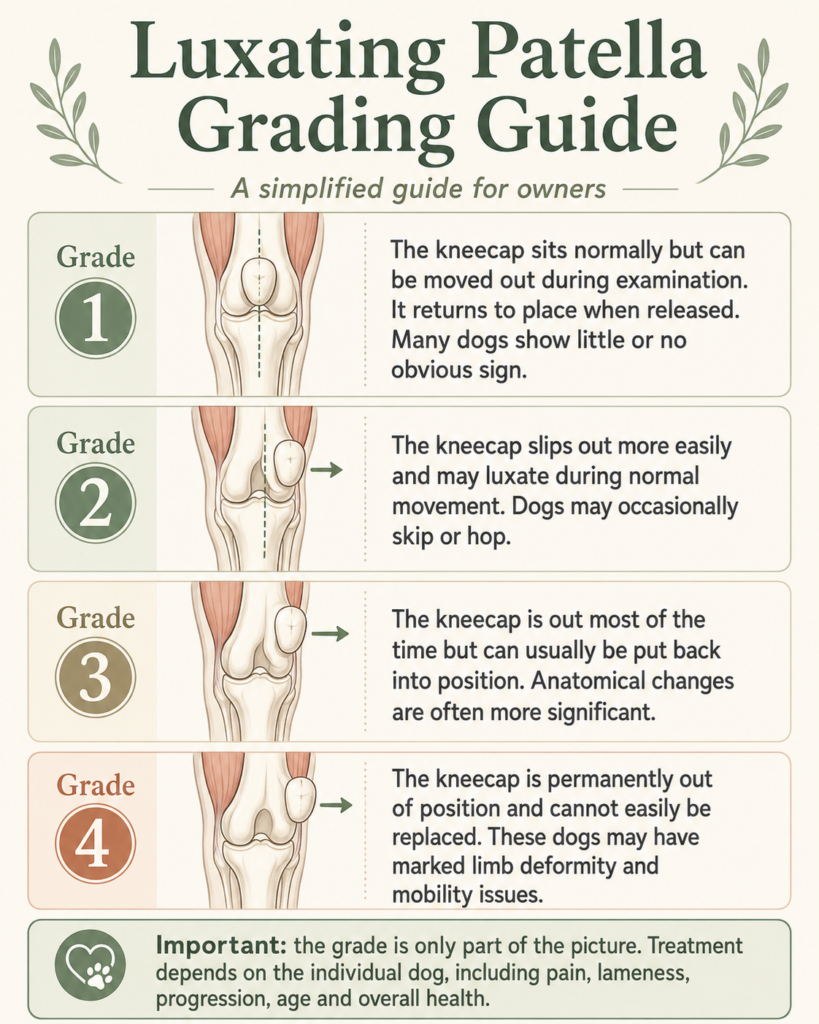
Grade 1
The kneecap normally sits within its groove but can be pushed out manually during examination. It returns to its normal position when released.
Many Grade 1 dogs have few or no clinical signs.
Grade 2
The kneecap can move in and out of position more readily and may luxate spontaneously during normal movement.
These are often the dogs owners notice occasionally “skipping”.
Some dogs remain comfortable with relatively infrequent episodes, while others become increasingly symptomatic.
Grade 3
The kneecap is luxated for much of the time but can generally be manually returned to its normal position.
There are usually more significant anatomical abnormalities present.
Grade 4
The kneecap is permanently luxated and cannot easily be replaced into its normal position.
These dogs can have substantial skeletal deformity and abnormal limb function.
The grade is important – but it is not the whole dog
A grading system is useful because it helps describe the physical instability of the patella.
But treatment decisions should not be made from a number alone.
Two dogs with the same grade of patellar luxation can be affected very differently.
One Grade 2 dog may occasionally skip for a few seconds and otherwise run, walk and play completely normally.
Another Grade 2 dog might experience frequent lameness, pain or progressive joint changes.
Age, clinical signs, frequency of luxation, skeletal conformation, arthritis, other orthopaedic disease and the dog’s overall health all need to be considered.
At Bliss, we strongly believe in treating the dog in front of us, rather than treating a grade.
Does every luxating patella need surgery?
No.
This is one of the most important messages we want owners to understand.
Veterinary guidance recognises a role for conservative treatment in dogs with mild clinical signs, particularly Grade 1 and selected Grade 2 cases. (PubMed Central (PMC))
Finding a luxating patella therefore does not automatically create an emergency and does not automatically mean surgery is necessary.
Instead, your vet should consider whether the knee is actually affecting your dog’s comfort and quality of life.
Conservative management
For dogs in whom surgery is not currently considered necessary, management may involve several different things.
Keep your dog lean
Maintaining a healthy body condition is one of the most useful things owners can do for a dog with any orthopaedic problem.
Extra body weight places additional load through the joints.
Being overweight does not necessarily cause the anatomical abnormality responsible for a luxating patella, but excess weight can make life considerably harder for an already abnormal knee.
Aim for a healthy, lean body condition rather than simply relying on the number shown on the scales.
Keep your dog appropriately active
Complete inactivity is rarely the answer for a comfortable dog.
Maintaining muscle mass, particularly around the hindquarters, helps support the joints and contributes to stability and mobility.
The appropriate amount and type of exercise will depend on the individual dog.
Regular, controlled exercise is generally preferable to long periods of inactivity followed by occasional bursts of intense activity.
Physiotherapy and rehabilitation
Veterinary physiotherapy can be very useful for selected dogs.
A qualified rehabilitation professional may use targeted exercises to improve strength, balance, proprioception and controlled movement.
Hydrotherapy may also be helpful for some dogs, although it should be individually prescribed rather than assumed to be suitable for every patient.
Manage pain and arthritis appropriately
If osteoarthritis or discomfort develops, veterinary treatment may include anti-inflammatory or other pain-relieving medication where appropriate.
Medication should always be discussed with your veterinary surgeon.
Conservative management can improve comfort and function, but it is important to understand that it does not physically correct the underlying anatomical abnormality responsible for the luxation. (Merck Veterinary Manual)
Dogs being managed conservatively should therefore still be monitored.
When might surgery be appropriate?
Surgery becomes more likely to be recommended when patellar luxation is causing a meaningful problem for the dog.
Reasons for referral or surgical consideration may include:
- persistent or significant lameness;
- frequent luxation interfering with normal activity;
- obvious pain;
- progressive worsening;
- significant skeletal deformity;
- higher-grade luxation;
- deterioration of the knee joint;
- substantial effects on mobility or quality of life.
Severe patellar luxation in a growing puppy is particularly important because abnormal forces through the developing limb can contribute to further skeletal deformity. The decision should therefore balance the consequences of leaving the condition untreated against the potential benefits and risks of surgical intervention.
What actually happens during patella surgery?
There is no single operation called “patella surgery”.
The procedure required depends on the anatomy of the individual dog’s knee.
Surgical treatment may include:
Deepening the trochlear groove
The groove in which the patella normally runs may be reshaped or deepened so the kneecap sits more securely.
Tibial tuberosity transposition
The point on the tibia where the patellar tendon attaches can be surgically repositioned.
This changes the direction of pull through the quadriceps mechanism and helps the kneecap track more normally.
Soft-tissue procedures
Tissues on one side of the knee may be tightened while tissues on the opposite side are released to improve alignment.
Corrective bone surgery
In dogs with substantial deformity of the femur or tibia, more complex orthopaedic surgery may sometimes be necessary to correct the alignment of the limb.
Frequently, more than one technique is used during the same operation.
For dogs requiring complex surgery, assessment by an experienced orthopaedic veterinary surgeon can be invaluable.
Patella surgery can be very successful – but it is not risk-free
For dogs whose patellar luxation is causing significant pain, lameness or loss of function, surgery can give a very good outcome.
UK referral specialists at Willows Veterinary Specialists describe the overall outlook following surgery for patellar luxation as generally good. However, as with any orthopaedic procedure, complications can occur. These include the kneecap luxating again and loosening or movement of surgical implants. (Willows)
This is particularly important because patellar surgery is not always a minor procedure.
Depending on the individual dog, treatment may involve deepening the groove in which the patella sits, repositioning the tibial tuberosity and securing it with pins or other implants, altering the surrounding soft tissues, or, in dogs with more severe limb deformity, cutting and realigning the femur or tibia.
The Royal Veterinary College also describes several different procedures used to correct medial patellar luxation, including tibial tuberosity transposition, implant placement and deepening of the patellar groove. More complex dogs may require additional corrective bone surgery. (Royal Veterinary College)
Possible complications following surgery can include:
- recurrence of the patellar luxation;
- loosening, movement or failure of surgical implants;
- infection;
- problems with bone healing;
- fracture or displacement of bone following procedures such as tibial tuberosity transposition;
- persistent lameness or stiffness;
- progression of osteoarthritis;
- and, in some cases, the need for further surgery.
A UK study involving dogs undergoing surgery for medial patellar luxation specifically investigated postoperative complications in small- to medium-sized dogs, reinforcing that complications are a recognised consideration when deciding whether surgery is appropriate. (Royal Veterinary College)
Other UK referral research has shown the same balance between good outcomes and genuine surgical risk. In one multicentre UK study of dogs undergoing surgery for lateral patellar luxation, 58 knees were operated on and 22 experienced one or more complications. Most could be managed conservatively, but some dogs required implant removal or revision surgery. Despite this, the final outcome was assessed as good or excellent in 47 of the 51 dogs available for follow-up. (Fitzpatrick Referrals)
This is why the decision to operate should be based on the individual dog rather than simply the presence of a luxating patella.
UK specialist guidance from Fitzpatrick Referrals, for example, states that Grade 2 medial patellar luxation is usually operated on when the dog is showing significant clinical signs such as lameness, while Grade 1 luxation is not considered a surgical condition. Higher-grade Grade 3 and Grade 4 luxations are more likely to require early surgical intervention because of the risk of progressive limb deformity and osteoarthritis.
At Bliss, we think owners should be given both sides of that discussion.
Surgical complications are not a reason to avoid an operation that a dog genuinely needs. Equally, putting a dog through orthopaedic surgery and rehabilitation should have a clear clinical benefit – the presence of a luxating patella alone is not enough.
The aim should always be to decide which option gives that particular dog the best chance of being comfortable and mobile in the long term.
What happens if we don’t operate?
Again, this depends enormously on the individual dog.
Some dogs with mild patellar luxation can remain comfortable for many years.
In other dogs, repeated movement of the patella out of its groove can damage the joint surface and contribute to progressive osteoarthritis.
As cartilage wears, the knee can become increasingly painful.
Patellar luxation is also associated with other problems within the knee, including cranial cruciate ligament disease.
This is why “no surgery” should not mean “ignore it forever”.
A conservatively managed dog should still be monitored for changes in gait, pain, frequency of luxation and general mobility.
Don’t assume every hind-leg problem is the patella
This is especially important in Cavaliers.
Our breed is predisposed to a number of neurological and musculoskeletal conditions.
A dog with a known Grade 1 or Grade 2 luxating patella may also develop:
- cranial cruciate ligament disease;
- osteoarthritis;
- hip problems;
- spinal pain;
- intervertebral disc disease;
- other neurological or orthopaedic disease.
If a dog has had a mild luxating patella for years and suddenly develops significant lameness, weakness or pain, it should not automatically be assumed that the patella is responsible.
The whole dog needs assessing.
Likewise, persistent weakness, wobbliness, unusual scratching behaviour, spinal pain or neurological changes deserve appropriate investigation rather than simply being labelled as a “bad knee”.
What can Cavalier owners do?
If your Cavalier has been diagnosed with patellar luxation:
Don’t panic.
Ask your vet:
- What grade is it?
- Is it affecting one knee or both?
- Does my dog appear painful?
- Do you believe the patella is responsible for the symptoms I am seeing?
- Is there evidence of arthritis?
- Are there other possible causes for the lameness?
- Would conservative management be reasonable?
- What should I monitor at home?
- What would make you reconsider surgery?
- If surgery is recommended, what procedure is proposed and why?
- What are the likely benefits, risks and recovery period for my individual dog?
A second opinion or orthopaedic referral is entirely reasonable where major surgery is being considered.
Why patellas matter in breeding
Patellar luxation should not simply be accepted as inevitable because Cavaliers are a small breed.
There is evidence of an inherited component to the condition, and veterinary surgical guidance recommends that affected dogs should not be used for breeding.
Breeding decisions influence far more than appearance.
Joint health, neurological health, cardiac health and overall welfare should all be part of responsible selection.
The high frequency with which we encounter patellar luxation in rescue Cavaliers reinforces the importance of breeders paying attention to orthopaedic health rather than dismissing a slipping kneecap as “just a Cavalier thing”.
The Bliss view
At Bliss Cavalier Rescue, our own study found patellar luxation in 22.6% of 177 Cavaliers examined.
Some were significant.
Others were mild.
Some dogs showed obvious symptoms.
Others had owners (including breeders) who had never noticed anything unusual at all.
And that perhaps sums up patellar luxation better than any grading chart can.
Not every luxating patella is the same, and not every dog with one needs surgery.
For some dogs, surgery can be transformative and prevent ongoing pain and deterioration.
For others, maintaining a lean body condition, preserving muscle strength, managing any discomfort and carefully monitoring the knee may be entirely appropriate.
Good veterinary medicine is not about treating an X-ray, a diagnosis or a number.
It is about looking at the whole dog – their pain, mobility, anatomy, age, health and quality of life- and choosing the option that gives that individual dog the best outcome.
Frequently Asked Questions About Luxating Patellas in Cavaliers
1. Does a luxating patella always need surgery?
No. Many Cavaliers, particularly those with a mild Grade 1 or some Grade 2 luxations, can live comfortably without surgery.
The decision should be based on the individual dog, including whether they are painful, how often the kneecap luxates, whether they are lame, whether the condition is progressing and whether there are changes such as osteoarthritis or limb deformity.
A diagnosis of a luxating patella does not automatically mean an operation is required.
2. Can a dog have a luxating patella without me noticing?
Absolutely.
Some dogs have very mild patellar luxation and show no obvious symptoms at all. It may only be discovered during a thorough veterinary examination.
At Bliss, we regularly identify luxating patellas during our nose-to-tail health checks in Cavaliers whose previous owners have never noticed any difficulty with their legs.
Other dogs show the more typical brief “skip”, where they lift one hind leg for a few steps and then suddenly use it normally again.
3. Will a luxating patella get worse as my Cavalier gets older?
Not necessarily, but it can.
Some mild luxating patellas remain stable for many years and cause very little difficulty. In other dogs, repeated abnormal movement of the kneecap can contribute to cartilage damage and osteoarthritis, resulting in increasing stiffness or discomfort.
This is why even a dog who does not require surgery should still be monitored. A change in the frequency of skipping, new lameness, reluctance to exercise or obvious pain should be discussed with your vet.
4. What can I do at home to help a Cavalier with a luxating patella?
One of the most important things you can do is keep your dog at a healthy, lean body condition. Excess weight adds unnecessary strain to an already abnormal joint.
Regular, appropriate exercise can also help maintain the muscles supporting the hind limbs. Some dogs benefit from veterinary physiotherapy, rehabilitation exercises or hydrotherapy.
At home, good grip on slippery floors and reducing unnecessary repetitive jumping may also help dogs who are struggling.
Exercise and rehabilitation should always be appropriate for the individual dog, particularly if your Cavalier has other orthopaedic, spinal or neurological conditions.
5. Is every skip or hind-leg problem in a Cavalier caused by a luxating patella?
No, and this is particularly important in Cavaliers.
The classic patella “skip” can certainly be caused by the kneecap temporarily moving out of position, but Cavaliers are also predisposed to several other orthopaedic and neurological conditions.
A dog may have a mild luxating patella that has caused no difficulty for years and then develop lameness from an entirely different problem.
Persistent lameness, weakness, wobbliness, pain, changes in gait or other neurological signs deserve a proper veterinary assessment rather than automatically being blamed on a known luxating patella.
Treat the dog, not simply the diagnosis.